Dongho Lee
Ph.D. Student · Dong-A University · ISPL

Dongho
Lee

Researching multi-scale 3D Gaussian Splatting and anti-aliased novel-view synthesis at the Image Signal Processing Lab, Dong-A University — building on earlier work in video coding (VVC) and Video Super Resolution. Advised by Prof. Dongsan Jun.

3 SCIE Papers (2026) KCI Publication 3 Patents Filed Best Paper Award NIA Gov. Project
Profile

About Me

I am a Ph.D. student in the Department of Computer Engineering at Dong-A University, Busan, South Korea, advised by Prof. Dongsan Jun in the Image Signal Processing Laboratory (ISPL), which I joined as an undergraduate researcher in 2022. I received my B.S. (2024) and M.S. (2026) from the same department.

My current research is multi-scale 3D Gaussian Splatting (3DGS) — keeping novel-view renderings sharp and alias-free from full resolution down to 128× zoom-out. My M.S. thesis and three 2026 SCIE journal papers approach this problem from the training-objective, color-representation and sampling-theory sides.

Before 3DGS I worked on video coding — VVC/ECM prediction tools and rate control — which led to 3 domestic patent filings, and on deep-learning Video Super Resolution, published in a KCI journal. I received the Best Paper Award from the Korea Multimedia Society in 2024.

Outside the lab, I built production front-end software for the Busan Smart City Digital Twin platform commissioned by the National Information Society Agency (NIA), and interned at ETRI’s Realistic Media Research Lab.

5
Publications
(3 SCIE · 1 KCI · 1 Conf.)
3
Patents Filed
(Korean Intellectual Property)
5
Open-Source
Projects
2
Awards
(Best Paper + Capstone)

2020 → Now

Research Journey

From video restoration, through video-coding standards, to multi-scale 3D Gaussian Splatting — each stage asked the same question: how do we keep image quality when the sampling rate changes?

← Swipe to see the whole timeline →

B.S. · 2020 – 2024
M.S. · 2024 – 2026
Ph.D. · 2026 –
2025
Pivot to 3D Gaussian Splatting
Moved from rate control to multi-scale 3DGS — rendering quality across zoom levels is an aliasing problem, the same family of problems as resolution change in video.
3DGSAnti-Aliasing

Why 3DGS — the field moved fast

Google Scholar results per year for the exact phrases “Neural Radiance Fields” and “3D Gaussian Splatting”
NeRF3DGS
Retrieved 2026-06-02. Scholar counts include preprints, theses and citing papers, so read them as a relative trend rather than exact paper counts; 2025 is still accumulating.

Case Studies

Research Highlights

Multi-scale 3DGS renders one scene at many zoom levels (1× → 128×). Gaussians fitted at full resolution break down when the camera zooms out: colors wash out, thin structures alias, and errors pile up at coarse scales. These two works attack that failure from different sides.

SCIE · Published Mathematics (MDPI) · 2026.07 · H. Park†, Y. Lee†, D. Lee, D. Jun*

Adaptive-Scale Color Offset and Error-Guided Gaussian Reallocation for Multi-Scale 3D Gaussian Splatting

ACO-EGR gives every Gaussian a small per-scale color correction and moves under-used Gaussians to where coarse-scale error stays high — without adding primitives.

+2.09dB
PSNR gain at 128× over MS-GS (Mip-NeRF 360)
+1.96dB
PSNR gain at 4× (Mip-NeRF 360)
3
Benchmarks improved from 4× onward: Mip-NeRF 360, Tanks & Temples, Deep Blending
±0
Extra Gaussians — reallocation runs under a fixed primitive budget
Problem At coarse scales one pixel averages many Gaussians, so a single fixed color per Gaussian is the wrong color once you zoom out.
Idea (a) ACOAdaptive-scale Color OffsetLearns a per-scale DC color offset Δs for each Gaussian — geometry stays untouched.(b) EGRError-guided Gaussian ReallocationMoves low-contribution Gaussians into regions where coarse-scale error stays high.
Result Higher PSNR and SSIM at every scale from 4× upward on all three datasets, with rendering time close to MS-GS.
Overview of ACO-EGR. Fig. 2 from Park et al., Mathematics 2026 (CC BY 4.0).

PSNR at every zoom level

Higher is better · hover for values
MS-GSOurs (ACO-EGR)

Drag to compare — MS-GS vs. Ours

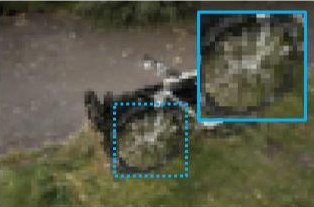
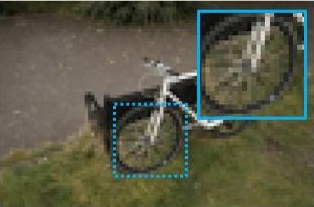
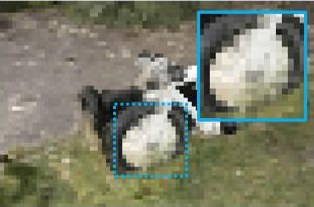
Same view rendered at a lower resolution; the boxed inset is a zoomed crop.
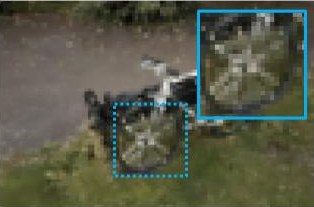
MS-GS rendering ACO-EGR rendering MS-GSOurs
↔
Ground truth
Ground truthGT
Vanilla 3DGS
3DGS rendering3DGS
Crops from Fig. 3 of Park et al., Mathematics 2026 (CC BY 4.0).
M.S. Thesis Dong-A University · 2026 · Advisor: Prof. Dongsan Jun

Multi-Scale 3D Gaussian Splatting with Region-Adaptive Structure Loss and Scale-Wise Weighting (RSIC-GS)

Prior anti-aliasing work fixes the renderer. RSIC-GS instead changes the training objective, so that structure-rich regions and coarse scales get the supervision they were missing — as a plug-in for existing backbones.

+0.51dB
Average PSNR gain over MS-GS across 1×–64× (Mip-NeRF 360)
+0.84dB
Largest single-scale gain, at 16×
2
Backbones it plugs into: MS-GS and Mip-Splatting
−2.3MB
Model size vs. MS-GS on Mip-NeRF 360 — no memory overhead
Problem A single loss treats every region and scale alike: structure-rich regions are under-supervised, and coarse scales dominate the summed loss while fine scales converge early.
Idea RASLRegion-Adaptive Structure LossLaplacian-domain residual between rendered and ground-truth images, auto-normalized per scale.SAWScale-Adaptive WeightingLearnable per-scale weights that rebalance the multi-scale loss.
Result Gains concentrate where MS-GS is weakest (4×–64×), at near-unchanged rendering time; ablation shows RASL and SAW are complementary (25.62 → 26.13 dB).
Training pipeline — (a) RASL, (b) SAW.

Gain over the MS-GS backbone

Mip-NeRF 360 · PSNR (dB) · hover for values
MS-GSMS-GS + RSIC-GS
bonsai (Mip-NeRF 360) — zoomed crops at 1×, 4×, 16×, 64×: MS-GS vs. MS-GS + Ours.
In the pipeline
IEEE Transactions on Multimedia · (Top 2% JCR Journal, IF=9.9) (Under First-Round Review)
Nyquist-Controlled Gaussian Splatting for Multi-Scale Artifact Reduction
Controls scale-dependent aliasing in multi-scale 3DGS using Nyquist sampling theory.
IEEE Transactions on Multimedia · (Top 2% JCR Journal, IF=9.9) (Under First-Round Review)
Region-Scale Coupled Training Objective for Consistent Multi-Scale 3D Gaussian Splatting
A training objective that couples region structure and scale for consistent quality across zoom levels.

Academic Output

Publications

SCIE Journal
2026
International Journal · SCIE Under Review
Nyquist-Controlled Gaussian Splatting for Multi-Scale Artifact Reduction
Y. Lee, D. Lee, H. Park, W. Cheong, H. Choo, and D. Jun*
IEEE Transactions on Multimedia  ·  Special Section: Generative AI for World Simulations and Communications
(Top 2% JCR Journal, IF=9.9) (Under First-Round Review)
3D Gaussian Splatting Multi-Scale Rendering Anti-Aliasing Nyquist Sampling
2026
International Journal · SCIE Under Review
Region-Scale Coupled Training Objective for Consistent Multi-Scale 3D Gaussian Splatting
D. Lee, Y. Lee, W. Cheong, H. Choo, and D. Jun*
IEEE Transactions on Multimedia  ·  Special Section: Generative AI for World Simulations and Communications
(Top 2% JCR Journal, IF=9.9) (Under First-Round Review)
3D Gaussian Splatting Multi-Scale Rendering Training Objective Region-Scale Coupling
2026
International Journal · SCIE
Adaptive-Scale Color Offset and Error-Guided Gaussian Reallocation for Multi-Scale 3D Gaussian Splatting
H. Park, Y. Lee, D. Lee, and D. Jun*
Mathematics (MDPI)  ·  July 2026
(Top 5% JCR Journal, IF=2.3) [PDF]
3D Gaussian Splatting Multi-Scale Rendering Anti-Aliasing Gaussian Reallocation
KCI Journal
2023
Journal · KCI Indexed
Video Super Resolution Method using Deformable Convolution based Alignment Network with Residual Dense Block
Dongho Lee, Yooho Lee, Sejin Chun, Dongsan Jun
Journal of Korea Multimedia Society, Vol. 26, No. 5, pp. 650–659, May 2023  ·  DOI: 10.9717/kmms.2023.26.5.650
VSR Deformable Convolution Residual Dense Block REDS Vimeo-90K +0.23 dB PSNR vs DCAN
Domestic Conference
2023
Conference · 한국방송미디어공학회 하계학술대회
Video Super Resolution Method using Deformable Convolution based Alignment Network with Lightweight Feature Extraction Block
Dongho Lee, Byungju Park, Youngwoo Lee, Sukhee Cho, Jangwu Jo, Dongsan Jun
2023 KIBME Summer Conference  ·  Supported by IITP (No. 2021-0-00087)
VSR Lightweight CNN LDCAN −38% Parameters vs DCAN Edge Device

Intellectual Property

Patents

Concept sketches drawn for this page (not the filed drawings): blue = existing candidates, gold = what each invention adds.

KR Patent
10-2025-0193072 · Filed 2025.12.08
Method for Augmenting TMRL Candidate List
TMRL candidate 추가 구성 방법 · Inventors: Dongsan Jun, Dongho Lee · Dong-A Univ. Industry–Academia Cooperation Foundation
Pending
TMRL: reference lines 1, 3, 5, 7 and 12 are searched; when lines 1 and 3 pick the same mode, intermediate line 2 is added.L1L2L3L5L7L12current blocksame mode onL1 and L3→ add L2searched linesadded lineskipped lines

Template-based multiple-reference-line prediction only searches a sparse set of lines (e.g. 1, 3, 5, 7, 12). When the same intra mode wins on two nearby lines, the intermediate line between them is likely even better — so it is added to the candidate list with almost no extra search.

KR Patent
10-2025-0193071 · Filed 2025.12.08
Method for Augmenting a TIMD Merge List
TIMD merge list 추가 구성 방법 · Inventors: Dongsan Jun, Dongho Lee · Dong-A Univ. Industry–Academia Cooperation Foundation
Pending
TIMD merge list: empty slots left by neighbour candidates are filled first with internal TIMD modes, then with block-vector-guided candidates.NbrNbrIntIntBVGBVGTIMD merge candidate list (Nmax slots)neighbour blocks① internal TIMD② block-vector guidedfusion weight & LocDep derived implicitly from the template — no extra bits

When neighbouring blocks cannot fill the TIMD merge list, the empty slots are filled first with modes from the block’s own template-matching (internal TIMD) step, then with block-vector-guided candidates. Fusion weights and position dependency are derived at the decoder, so no side information is sent.

KR Patent
10-2024-0071658 · Filed 2024.05.31
Template Matching-based Pair-wise Average Motion Vector Prediction Candidate List Extension
Template matching 기반 pair-wise average MVP 후보 목록 확장 방법 · Inventors: Dongsan Jun, Taesik Lee, Dongho Lee
Pending
Pair-wise average MVP: two merge candidates are averaged over an extended set of reference indices, ranked by template-matching SAD and inserted into the merge list.MV cand. 0MV cand. 1avgref idx 0ref idx 1ref idx 2extended ref. indicestemplate SAD ↓insert into merge list

Pair-wise average MVP candidates normally use a restricted reference index. The invention averages merge candidates over an extended set of reference indices, ranks them by template-matching SAD, and inserts the best into the merge list.


Selected Work

Projects

Deep Learning

VideoSR — RDAN

Video Super Resolution using Residual Dense Alignment Network (RDAN). Achieves +0.23 dB PSNR improvement over DCAN on REDS4 benchmark. Published in KCI Journal of Korea Multimedia Society (2023).

Python PyTorch REDS Vimeo-90K Tesla V100
3D Vision

3DGS-Analyzer

Analysis and evaluation toolkit for 3D Gaussian Splatting scenes. Supports scene statistics, quality metrics, and visualization of Gaussian primitives for research in novel-view synthesis.

Python 3D Gaussian Splatting Novel View Synthesis
Gov. Project

Light Pollution Simulation

Front-end for Busan Metropolitan City's 1365 Smart City Digital Twin Platform ("Urban Artificial Lighting Safety Service"), commissioned by NIA. Features real-time 3D heatmap, light-source simulation, and admin dashboards. Live at 1365twin.busan.kr.

3D Digital Twin WebGL GIS Real-time
NIA Gov. Project · Busan Metropolitan City
LiDAR

Pedestrian Safety System

LiDAR-based obstacle detection system providing directional audio warnings for visually impaired pedestrians. Won Capstone Design Award at Dong-A University. Research paper presented at IEEE conference.

3D LiDAR Point Cloud Obstacle Detection Audio Guidance
Unreal Engine

Interactive Planetarium (VR)

3D interactive planetarium built in Unreal Engine — explore and learn about 52 constellations in virtual reality. Demonstrates real-time 3D rendering and interactive XR design.

Unreal Engine C++ VR 3D Interactive

Recognition

Awards & Honors

Best Paper
2024
최우수논문상 (Best Paper Award)
한국멀티미디어학회 (Korea Multimedia Society) · Dong-A University
Capstone
Capstone Design
Capstone Design Award — Pedestrian Safety System
Dong-A University · LiDAR-based Walking Assistance System for Visually Impaired
NIA
2023 – Present
NIA Government-Commissioned Project Contributor
National Information Society Agency (NIA) · Busan 1365 Digital Twin Platform

Background

Education

2026.09 – Present
Ph.D. in Computer Engineering
Dong-A University, Busan, South Korea
Advisor: Prof. Dongsan Jun  ·  Lab: Image Signal Processing Lab (ISPL)
Research: Multi-scale and anti-aliased 3D Gaussian Splatting
2024.03 – 2026.02
M.S. in Computer Engineering
Dong-A University, Busan, South Korea
Thesis: Multi-Scale 3D Gaussian Splatting with Region-Adaptive Structure Loss and Scale-Wise Weighting
Research: Video coding (VVC/ECM, rate control) → 3D Gaussian Splatting
2020.03 – 2024.02
B.S. in Computer Engineering
Dong-A University, Busan, South Korea
Capstone Design Award recipient

Technical Stack

Skills

Deep Learning / ML

PyTorch Python CNN Design Deformable Conv Attention Mechanism Dense Connections

Computer Vision / Graphics

3D Gaussian Splatting Video SR Image Quality (PSNR/SSIM) LiDAR / Point Cloud WebGL GIS Visualization

Systems & Tools

Unreal Engine C++ Digital Twin NVIDIA GPU (V100) Git / GitHub Linux